
Turn your strategic decisions into a competitive advantage
Bring your teams together to test your choices against competitor moves, crises and market disruptions — and leave with a structured, evidence-based strategic action plan ready for execution.
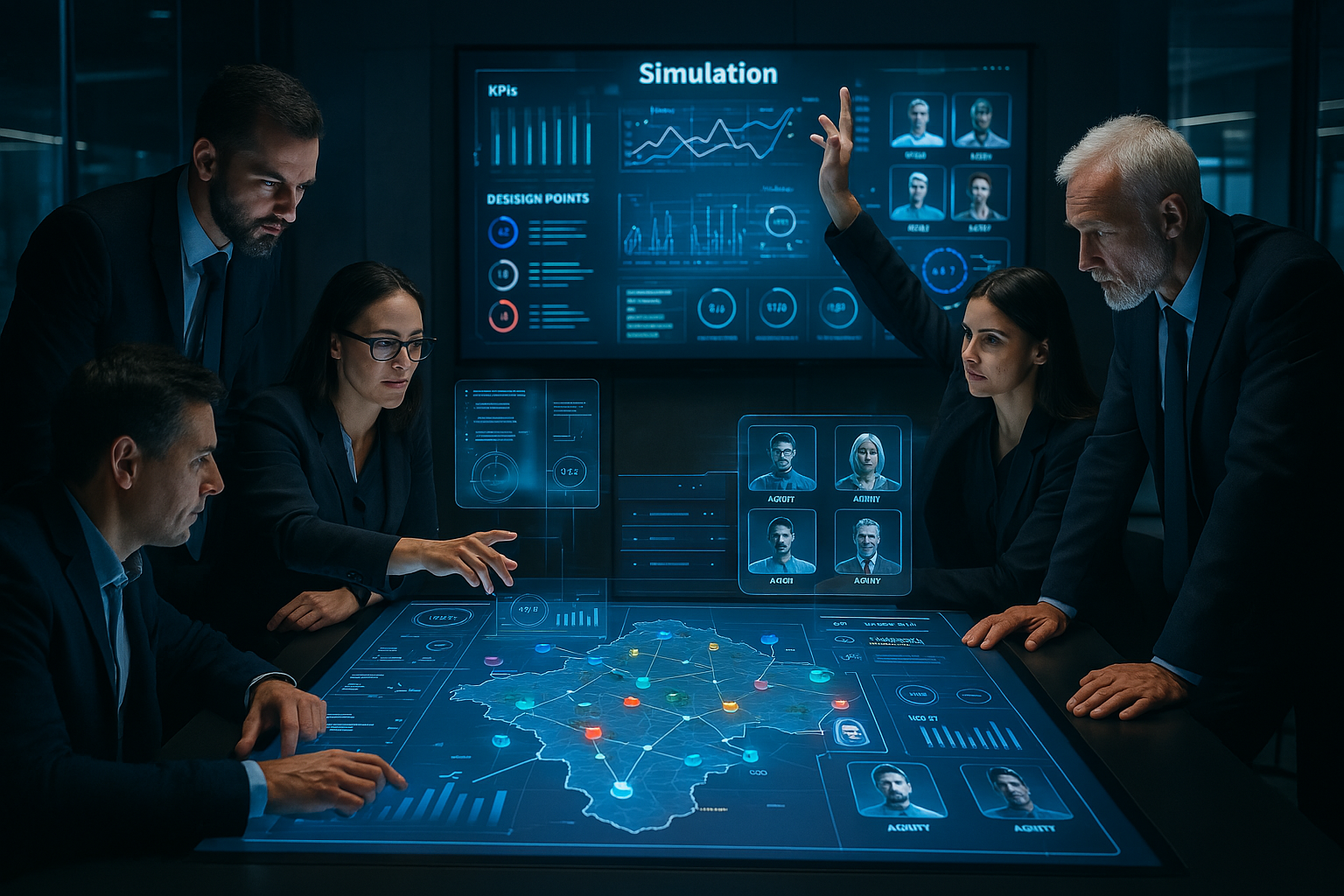
Test your decisions on the fronts that matter
A war game exposes your teams to realistic and dynamic situations. Where analysis alone may reassure, simulation reveals chain reactions, blind spots and losing scenarios — before they become reality.
Competitive dynamics
Anticipate the likely moves of key players — product launches, price wars, acquisitions, repositioning — and prepare your countermeasures.
Crisis management
Stress-test your response capability against a shock: regulatory disruption, major failure, reputational attack or sudden market reversal.
Scenario planning
Explore multiple possible futures and assess the robustness of your decisions in uncertain and unstable environments.
Strategic action plan
Convert the simulation into clear decisions: risks, opportunities, priority actions and next steps that can be immediately used in executive committees.
More than a workshop: a managed enterprise framework
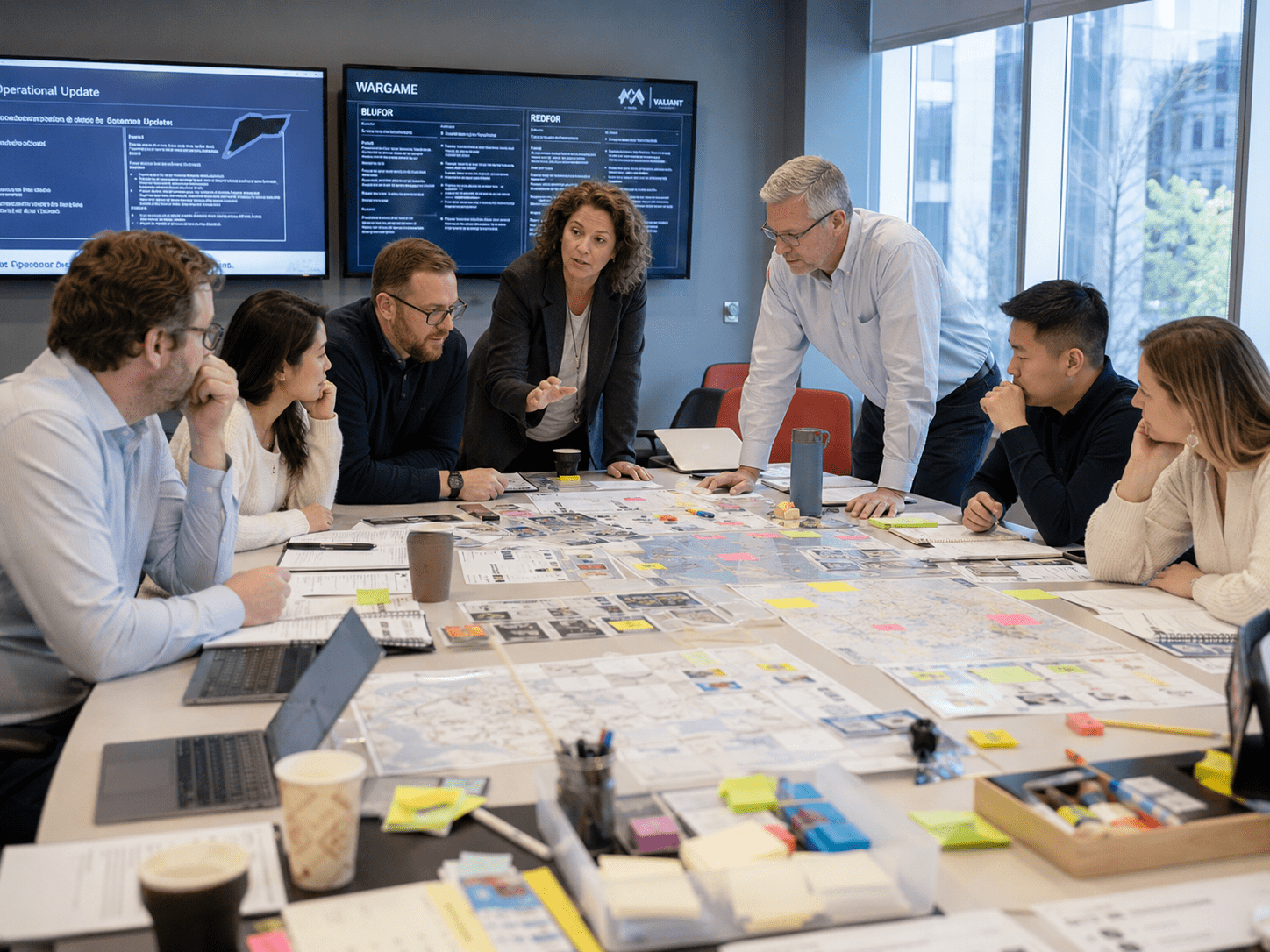
A war game is a real collective exercise, with teams, rules, organization and expected deliverables. The HUMIND platform orchestrates the entire framework to produce actionable results, not just another discussion session.
Teams and roles
Participants are divided into teams, strategic roles are assigned, and shared dilemmas are challenged round after round.
A structured organization
Objectives, critical questions, decision rules and session flow are formalized to ensure a controlled exercise from start to finish.
Expected deliverables
Round summaries, risk matrices, evaluated scenarios and prioritized action plans — results ready for your decision-making bodies.
A platform to design, facilitate and leverage every war game
From preparing competitive scenarios to producing the final action plan, the HUMIND platform structures every phase of the framework and captures the value of all your sessions.
Game design
Scenario library — competitive pressure, crisis, disruption, scenario planning — preconfigured strategic roles and structured session phases to frame the exercise quickly.
Multi-team facilitation
Manage participants, teams, rounds and real-time injected events. Each team submits decisions, triggers reactions and countermeasures, and has its impact assessed.
Augmented analysis
At each round, the platform consolidates:
- Key learnings and weak signals detected
- Major risks and opportunities revealed
- Winning scenarios vs. losing strategies
- Recommended and prioritized decisions
Integrated action plan
Each recommendation becomes a structured action plan: sequenced steps, accountable departments and documented follow-up. The war game no longer ends in the meeting room.
Multi-team, multi-industry
Industry reference frameworks, centralized briefs and documents, decision traceability: a common framework to manage your programs and build long-term capitalization.
Specialized AI agents
AI agents challenge your assumptions, simulate competitor behavior and accelerate impact analysis, round after round.
The workshop that fades, or the framework that compounds value
The difference does not lie in participant talent, but in what remains once the session is over.
Designed for those who make decisions under uncertainty
Strategy & innovation leaders
Anticipate market disruptions and secure your investment decisions against simulated competitors.
Executive committees & business units
Test your major strategic directions — budget, positioning, growth — before committing to them.
Crisis management & risk teams
Train your responses to regulatory, reputational or operational shocks.
Consulting firms & business schools
Industrialize your war gaming offer and train executives through realistic exercises.
Train for the future before your competitors do
HUMIND designs, facilitates and leverages your strategic simulations, supported by a dedicated platform — from competitive dynamics to action planning.
“The organizations that win are not the ones that predict the future — they are the ones that train for it.

